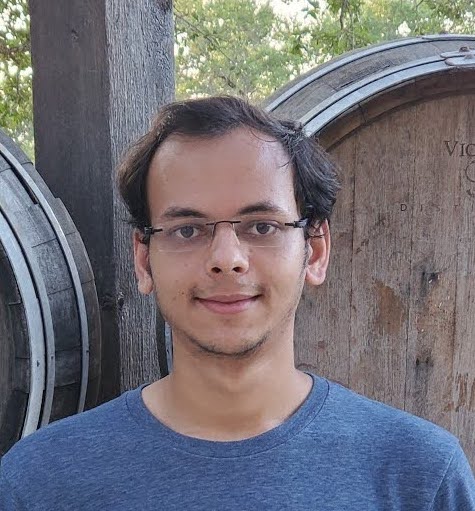
Kanishk Jain
I am a postdoctoral researcher in Tankut Can's group studying how learned representations and inference-time computation can expose and control structure in complex, high-dimensional systems like Large Language Models. Specifically, I study inference-time methods for langauge models, including scaling test-time compute while tuning output diversity, and systematic evaluation of open-weights models1,3.
Previously, during my PhD in Physics with Gordon Berman, I developed recurrent neural network models for extracting interpretable structure from high-dimensional behavioral2,5 and neuromechanical dynamics4.
Research Interests
My interest lies in understanding how complex, high-dimensional systems can be reduced to representations that are both predictive and interpretable, and how these representations can be used to understand or control system behavior.
My current research focuses on how inference-time interventions change the behavior of language models: how alternative tokenizations affect generation and test-time computation, and how these effects can be characterized systematically in open-weight models. This builds on my earlier work in using recurrent models to discover low-dimensional, individual-specific structure from data.
Selected Publications
- Emergent retokenization symmetry in large language models: phenomenology and applications. arXiv preprint, arXiv:2606.15521, 2026. link
- Using timescale as a state coordinate reveals the metastable geometry of behavior. bioRxiv, 2026.05.25.727718, 2026. link
- Generating output diversity from prompt re-tokenization. Workshop on Scientific Methods for Understanding Deep Learning, ICLR 2026. link
- Discovering individual-specific gait signatures from data-driven models of neuromechanical dynamics. PLOS Computational Biology, 19(10), 2023. link
- Anticipating persistent infection. EPL, 121(6), 2018. link
- Evolutionary adaptations of biofilms infecting cystic fibrosis lungs promote mechanical toughness by adjusting polysaccharide production. npj Biofilms and Microbiomes, 2016. link